
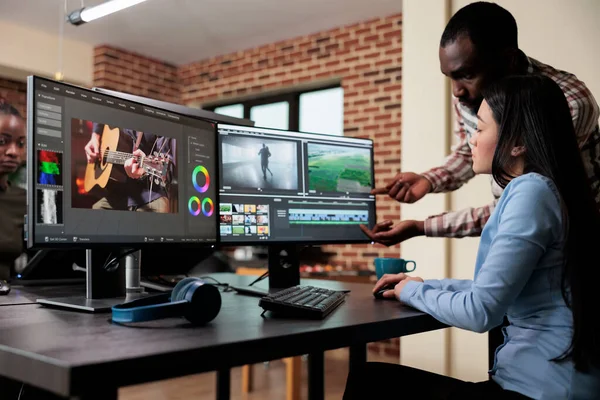
Artificial intelligence first entered video editing through relatively narrow features.
Automatic captions, background removal, noise reduction, and simple scene detection helped editors complete repetitive tasks faster. Useful, certainly, but these functions mostly improved existing workflows rather than changing them.
That distinction is now starting to disappear.
A newer generation of AI systems is influencing how videos are planned, assembled, revised, and repurposed. Instead of acting as a collection of isolated shortcuts, AI is becoming part of the production process itself. The result is a broader shift from task automation toward workflow transformation.
From Task Automation to Workflow Intelligence
Traditional automation generally solves one problem at a time. A tool might generate subtitles, remove pauses, resize a clip, or identify speakers. The editor still has to coordinate those outputs manually and decide how they fit into the larger project.
AI-driven workflows take a different approach. They can connect multiple stages of production around a single objective.
For example, a creator might start with a long interview and ask an AI system to identify key themes, suggest shorter segments, create captions, generate titles, and prepare different versions for multiple platforms. The individual tasks are not especially new. What changes is the way they are linked together.
Why That Difference Matters
When repetitive decisions become easier to manage, editors can spend more time thinking about structure, narrative, pacing, and audience. The technology becomes less about replacing individual clicks and more about reorganizing where human attention is spent.
Natural Language Is Becoming a New Editing Interface
Video software has traditionally required users to understand timelines, tracks, keyframes, menus, effects panels, and other technical controls. Those interfaces remain important, especially for precise work, but natural-language systems are adding another layer.
A creator can increasingly describe what should happen rather than manually performing every action.
Instructions might include shortening a scene, removing pauses, identifying the strongest quote, changing the pacing, generating captions, or adapting a landscape video for a vertical format.
Tools built around concepts such as an AI video editor with ChatGPT illustrate how conversational interfaces can become part of that process. Instead of treating AI as a separate utility, these systems point toward editing environments where prompts and traditional controls work together.
The important change is not that text prompts replace the timeline. It is that creators gain another way to communicate their intentions to the software.
AI Is Moving Earlier Into the Production Process
AI-assisted video creation is also expanding beyond post-production.
Before editing begins, creators can use AI to organize scripts, summarize research, outline scenes, develop shot lists, and explore different narrative structures. That means editing decisions can start influencing a project before any footage reaches the timeline.
Consider a marketing team preparing several versions of the same campaign video. Traditionally, the team might produce one main edit and then manually adapt it for different platforms.
An AI-assisted workflow could help plan those variations earlier. The system might identify which scenes work for short-form formats, suggest different opening hooks, and organize material based on audience or platform requirements.
Editing Systems Are Becoming More Context-Aware
Perhaps the most significant development is that AI can analyze several types of information at once.
Modern systems may process speech, transcripts, visual elements, scene changes, objects, and timing. This enables capabilities such as transcript-based editing, automated reframing, highlight detection, and content summarization.
Context matters because video editing is rarely about individual clips in isolation.
A technically clean cut can still damage the flow of a conversation. A visually impressive transition may feel completely wrong for the story. Understanding those relationships remains difficult, but AI systems are gradually becoming better at interpreting them.
That moves the technology closer to assisting with decisions rather than merely executing commands.
Human Editors Are Moving Toward Higher-Level Decisions
None of this removes the need for human judgment.
Storytelling, emotional timing, factual accuracy, brand consistency, and cultural context are difficult to reduce to simple instructions. AI may recommend an edit, but a person still has to decide whether that edit actually serves the purpose of the video.
Instead of manually performing every technical action, editors may spend more time directing systems, reviewing alternatives, refining outputs, and making higher-level creative choices.
In that sense, AI becomes closer to a production assistant than an autonomous editor.
The Limitations Still Matter
Systems can misunderstand prompts, select weak moments, create repetitive edits, or lose important context. Generative tools can also introduce continuity problems or produce material that does not match the intended tone.
There are broader concerns too. Copyright, privacy, training data, consent, and ownership become increasingly important when AI is involved in creating or modifying media.
What the Next Generation of Video Editing Could Look Like
Scripting, asset generation, editing, transcription, localization, and publishing may increasingly exist inside connected AI-assisted environments. A creator could move from an initial idea to several finished versions of a video without constantly switching between disconnected tools.
Traditional editing controls are unlikely to disappear. Precision still matters.
What may change is the overall relationship between creator and software. Instead of telling an application exactly which buttons to execute, creators will increasingly describe what they want to achieve and then refine the system's interpretation.
Conclusion
AI video editing is becoming more significant because it is changing the structure of production, not simply making familiar tasks faster.
The move toward conversational interfaces, contextual analysis, and connected production stages suggests a future where editing software behaves less like a passive toolbox and more like an active production environment.
The real transformation, then, is not automation alone. It is the gradual redesign of the entire creative workflow around collaboration between human judgment and machine assistance.