
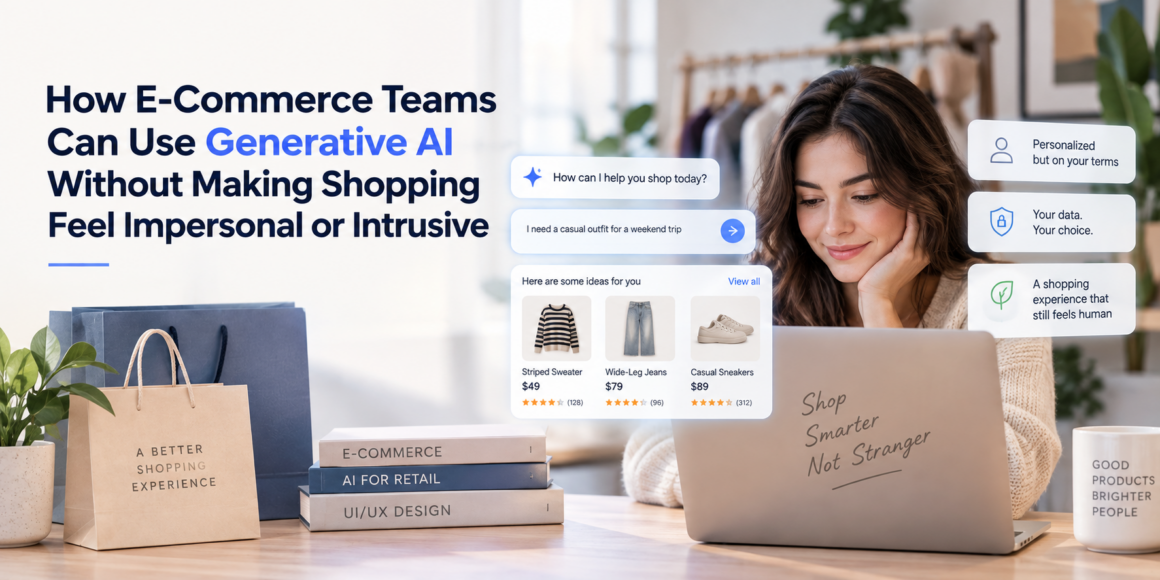
Generative AI – ChatGPT, Claude, Gemini or any one of your preference – can help shoppers describe what they need, compare products, ask questions, and navigate large catalogs without working through layers of filters.
The same technology can damage the experience when it knows more than customers expect, produces generic responses, interrupts familiar shopping journeys, or pushes people toward decisions they did not ask AI to make.
For e-commerce teams, the goal should not be maximum personalization. AI should reduce customer effort while preserving choice, privacy, brand character, and access to conventional shopping journeys.
That makes generative AI as much a UI/UX design challenge as a technology decision.
Where Generative AI Can Improve E-Commerce Experiences
Traditional e-commerce discovery depends on keywords, categories, filters, and product attributes. Generative AI can give customers another way to express what they need.
A shopper looking for running shoes might describe where they run, their preferred fit, and their budget. AI can interpret that request and narrow the catalog using available product information.
Product comparison offers another practical use. Instead of moving between several pages, customers can ask how selected products differ in dimensions, materials, specifications, compatibility, or other documented attributes.
AI can also summarize complex product information or answer questions from approved catalog data.
These use cases share an important characteristic: the customer asks for assistance.
That boundary matters. AI tends to feel more useful when it responds to an expressed need rather than predicting what a shopper wants before being invited into the journey.
For teams working on e-commerce app development, this provides a sensible starting point. Use AI first where it reduces search and decision effort. Add deeper personalization only when the customer benefit and data requirements are clear.
How AI Becomes Intrusive or Impersonal
Intrusive and impersonal AI are different UX failures.
Intrusive AI creates the feeling that the system knows more about the customer than expected. Impersonal AI creates the opposite problem: the system is speaking directly to the customer but does not understand what they need.
Both can weaken trust.
Keep Hidden Customer Data Hidden
A retailer may have access to purchase history, browsing behavior, account information, saved products, and inferred preferences. That does not mean an AI assistant should expose or use all of it in every interaction.
Generated responses should rely on information required for the task. Teams should also distinguish between information customers provide during the current interaction and information collected through other channels.
When personalization uses account history or saved preferences, the interface should give customers enough context to understand why the experience has changed.
Do Not Replace Brand and Human Context With Generic AI
Generative AI can produce grammatically correct responses that still feel disconnected from the retailer.
A premium fashion store, electronics marketplace, and grocery platform should not sound like the same chatbot. Product terminology, tone, service policies, and interaction patterns need to reflect the actual shopping environment.
AI should not become a barrier between customers and useful human support either. A shopper dealing with a damaged order, payment problem, accessibility issue, or unusual product question may need an escalation path rather than another generated response.
The objective is not to make AI sound human. It is to make the interaction useful within the context of the brand and task.
Keep Commercial Pressure Visible
AI recommendations can become problematic when commercial priorities are hidden behind conversational language.
Sponsored products, promotions, and merchandising rules should not appear to be neutral AI judgment when business logic influences the result.
The same principle applies to urgency. AI should not use personalized language to manufacture pressure or make privacy and purchasing choices harder to understand.
Design Generative AI Around Customer Control
Strong UI/UX design services for AI-enabled commerce should answer one question: can customers understand and control what is happening?
Start with visibility. Customers should know when they are interacting with AI.
The interface should also handle uncertainty. If the system cannot verify a product specification, availability detail, or policy, it should say that the information is unavailable rather than generate a plausible answer.
Choice is equally important. Customers should be able to dismiss an assistant, return to standard search, correct information, change relevant preferences, or reach human support when the situation requires it.
Teams can use progressive personalization instead of applying the same level of personalization to everyone. An anonymous visitor might receive assistance based on the current query and catalog. A signed-in customer who chooses a personalized experience may allow the system to use saved preferences or previous purchases.
UX research should then examine more than task completion. Teams can test whether shoppers understand why recommendations appear, whether AI interrupts familiar behaviors, whether responses reflect the shopping context, and whether privacy choices are clear.
Conversion remains important, but it should not be the only measure of whether an AI shopping experience works.
5 US E-Commerce and UX Providers for AI-Enabled Shopping Experiences
Teams introducing AI into commerce may need e-commerce engineering, UX research, interface design, AI integration, and customer-experience expertise. The following US-based providers have capabilities relevant to parts of that work.
1. GeekyAnts
GeekyAnts is an AI-Powered Digital Product Engineering & Consulting Company. Its e-commerce engineering work covers mobile and web products, AI-enabled features, backend systems, design systems, and UI/UX design. Its portfolio includes work for Pepperfry, where the engagement addressed fragmented interface patterns through an atomic design system. This combination is relevant when generative AI needs to fit product discovery, catalog navigation, customer support, and established shopping journeys instead of operating as an isolated interface.
Clutch Rating: 4.9 (120 reviews)
Address: GeekyAnts Inc, 315 Montgomery Street, 9th and 10th floors, San Francisco, CA 94104, USA
Phone: +1 845 534 6825, Email: [email protected], Website: www.geekyants.com/en-us
2. Mira Commerce
Mira Commerce is a California-based e-commerce company focused on digital commerce platforms, customer experience, and managed services. Its current capabilities include conversational AI, AI-driven merchandising and personalization, AI prototyping, and UX optimization for commerce experiences. This combination is relevant to retailers considering where generative AI should enter discovery, recommendations, customer service, and personalization while remaining connected to the wider commerce architecture and customer journey.
Clutch Rating: 4.7 (25 reviews)
Address: 2121 North California Blvd., Suite 290, Walnut Creek, CA 94596, USA
Phone: +1 415 456 5600
3. Americaneagle.com
Americaneagle.com is an Illinois-based digital agency providing e-commerce, UX, engineering, accessibility, AI, and managed digital services. Its multidisciplinary model is relevant to commerce teams that need to evaluate AI alongside the complete customer experience rather than as a standalone chatbot. The combination of UX, commerce engineering, accessibility, and AI capabilities can support work across product discovery, conversational assistance, customer journeys, interface design, and the systems that deliver those experiences.
Clutch Rating: 4.7 (10 reviews)
Address: 2600 South River Road, Des Plaines, IL 60018, USA
Phone: +1 877 932 6691
4. Commerce Pundit
Commerce Pundit is a Georgia-based e-commerce development company with capabilities across e-commerce design and development, Shopify, Magento, AI development, automation, and digital experience work. Its commerce focus is relevant when retailers need AI functionality to connect with catalogs, storefronts, customer journeys, and existing commerce platforms. This breadth can support teams exploring AI-assisted discovery or customer interactions without separating those features from the technical systems responsible for the wider shopping experience.
Clutch Rating: 4.7 (31 reviews)
Address: 2675 Breckinridge Blvd., Suite 250, Duluth, GA 30096, USA
Phone: +1 770 285 8191
5. Big Drop
Big Drop is a New York-based digital agency working across UX/UI design, web development, e-commerce experiences, digital strategy, and AI services. Its portfolio includes e-commerce design work, while its AI practice covers data evaluation, solution design, testing, implementation, and post-launch support. These capabilities are relevant to commerce teams that need to consider how an AI interaction fits the wider interface, customer journey, brand experience, and existing digital platform.
Clutch Rating: 4.6 (36 reviews)
Address: 169 Madison Avenue, Suite 15613, New York, NY 10016, USA
Phone: +1 212 244 3767
Conclusion
Generative AI does not need access to every customer signal to improve an e-commerce experience. Its strongest role may be helping shoppers express what they need, understand products, compare choices, and move through large catalogs with less effort.
The design challenge is maintaining the customer’s sense of control. Intrusive AI can make shoppers question how much a retailer knows about them, while impersonal AI can replace useful brand or human interactions with generic responses. Neither outcome creates a better shopping journey.
E-commerce teams should therefore evaluate AI through customer understanding, transparency, choice, and task completion alongside commercial performance. The useful question is not how much personalization the technology can produce. It is whether AI helps customers make decisions without taking control of those decisions away from them.