
The Relentless Math of the Modern Broadcast Calendar
Let’s be real for a second. Autumn used to mean a distinct, manageable pocket of time where one partner vanished into the television on a lazy Sunday afternoon. That quaint, predictable era is completely dead and buried. The sports ecosystem we deal with today operates on a continuous, aggressive loop of domestic and international scheduling. Entire weeks simply evaporate into the ether. You aren’t just competing with standard weekend fixtures anymore; you are fighting a losing battle against the Wednesday night vortex of “MACtion” and the inescapable sprawl of global soccer leagues. Broadcast networks have engineered a relentless machine to extract human attention across every single time zone. This sheer density of programming creates a tangible, logistical nightmare for any household trying to maintain a baseline of normal relational interaction. Your partner hasn’t suddenly decided to actively ignore you in favor of a screen. The sports industry simply built a calendar designed to monopolize every waking hour of their discretionary time.
The Parasocial Elephant in Your Living Room
Let’s be real about the tension in your living room during a playoff push. It has zero to do with a piece of pigskin crossing a chalk line. Your partner’s brain actually maps their own self-worth directly onto the success of complete strangers. We are talking about clinical, borderline unhealthy parasocial relationships here. Ask them to mute the television for five minutes, and their nervous system registers a direct attack on their actual friends. The Gottman Institute calls the television a massive “bid-blocker.” A bid is any microscopic attempt to connect: a frustrated sigh, a quick touch on the arm, a random observation about a terrible beer commercial. Fanatics staring at a glowing screen routinely ignore these vital bids. They turn away from their partner entirely, leaving the non-fan feeling like a localized, heavily burdened ghost in their own home.
The Myth of Forced Quality Time
Instagram therapists love selling this idea that healthy partners need to do every single activity together. Frankly, that is terrible advice. Your weekend downtime instantly turns into a chore the minute someone forces you to participate. You might want to binge a murder documentary upstairs. Your partner might want to curse at a referee on the main couch. That geographical split does not mean your marriage is failing. It just means you both value your sanity enough to embrace completely different definitions of relaxation. You absolutely do not need to understand the intricate mechanics of a zone blitz to validate your partner’s existence. The Gottman framework categorizes intense sports fandom as a perpetual problem. This fundamental lifestyle difference cannot be cured. It can only be managed through careful, rigid compromise.
Weaponizing Adult Parallel Play
The actual solution to this temporal standoff involves a concept developmental psychologists call parallel play. Kids actually master this concept in the sandbox. One builds a castle. The other eats dirt. Neither expects a conversation. Grown adults completely lose this ability somewhere along the way, replacing it with a needy demand for constant attention. You can actually share a single piece of furniture while entirely ignoring each other. Your nervous system still registers the physical safety of your partner being nearby, dropping your heart rate without requiring a single word of forced small talk. Your partner can agonizingly track their fantasy football roster while you fall down a dense social media rabbit hole, and your bodies will still secretly co-regulate. The catch? You have to establish ruthless, intentional physical boundaries. Silence must be the default expectation in the room. Neither party is allowed to demand a deep, meaningful conversation until the fourth-quarter clock officially hits zero.
Manufactured Stakeholders and the Magic of the Micro-Wager
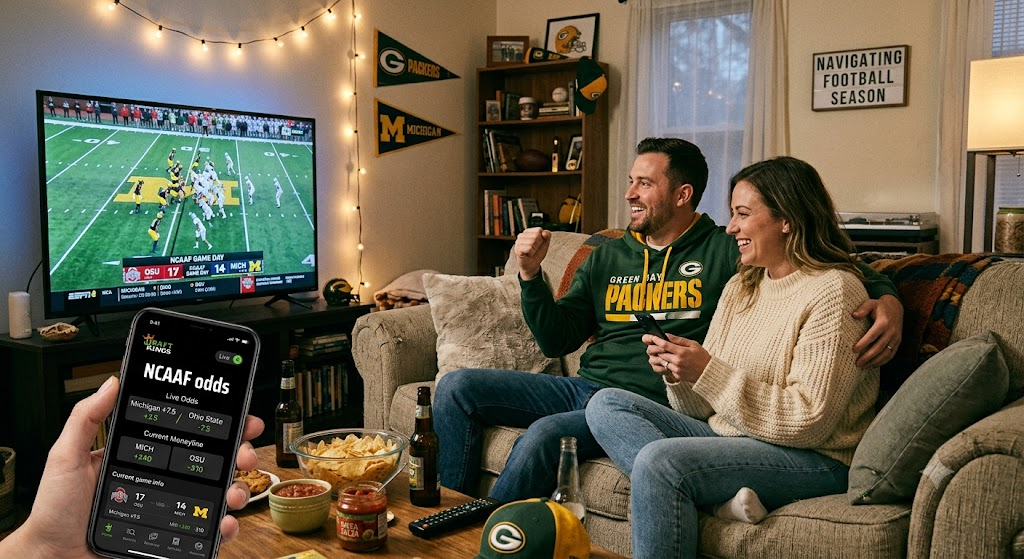
Frankly, sometimes the easiest way to survive a deeply boring broadcast is to artificially hack your own brain chemistry. If you absolutely must watch the game together for diplomatic reasons, you need a way to manufacture personal investment without actually caring about the sport itself. This brings us to the brilliant, slightly manipulative architecture of modern gamification. Oddsmakers deliberately level the playing field between wildly unequal teams by using point spreads. This transforms a highly complex athletic contest into a highly digestible binary outcome. You don’t need to know the backup quarterback’s name to understand that the underdog just needs to lose by less than seven points to trigger a payout. You can instantly acquire a tiny piece of financial skin in the game. Open your phone right now. Check the NCAAF odds for a random weeknight matchup, drop a micro-bet on a heavy underdog, and watch your indifference vanish. The television screen suddenly floods your brain with the exact same unpredictable dopamine hits your partner is experiencing. You are no longer a passive, bored observer trapped on a sofa. You become an active, highly stimulated participant riding a synchronized emotional roller coaster.
Hedging Your Marital Bets
Financial reality dictates that this specific engagement strategy comes with immediate, non-negotiable caveats. The commercial sports betting industry is mathematically designed to separate you from your capital over the long term. It relies heavily on the psychological illusion of user control. If you choose to weaponize gamification to survive the football season, those wagers must be drawn exclusively from isolated discretionary entertainment budgets. A lost bet should never, under any circumstances, impact the monthly grocery bill or the rent payment. If digital sportsbooks feel too financially risky for your household dynamic, couples can easily pivot to interpersonal wagering. Partners can bet a thirty-minute back rub on the outcome of the opening coin toss. You might even wager a full week of dishwashing duties on the total number of field goals kicked in the second half. A stupid bet over the coin toss suddenly turns a deeply boring Sunday into an inside joke. The reality is, nobody actually expects you to magically care about the secondary in a Cover 2 defense. Your only real objective is hacking the situation just enough to survive the afternoon together. Share the room, keep your money safe, and weaponize your boredom.