
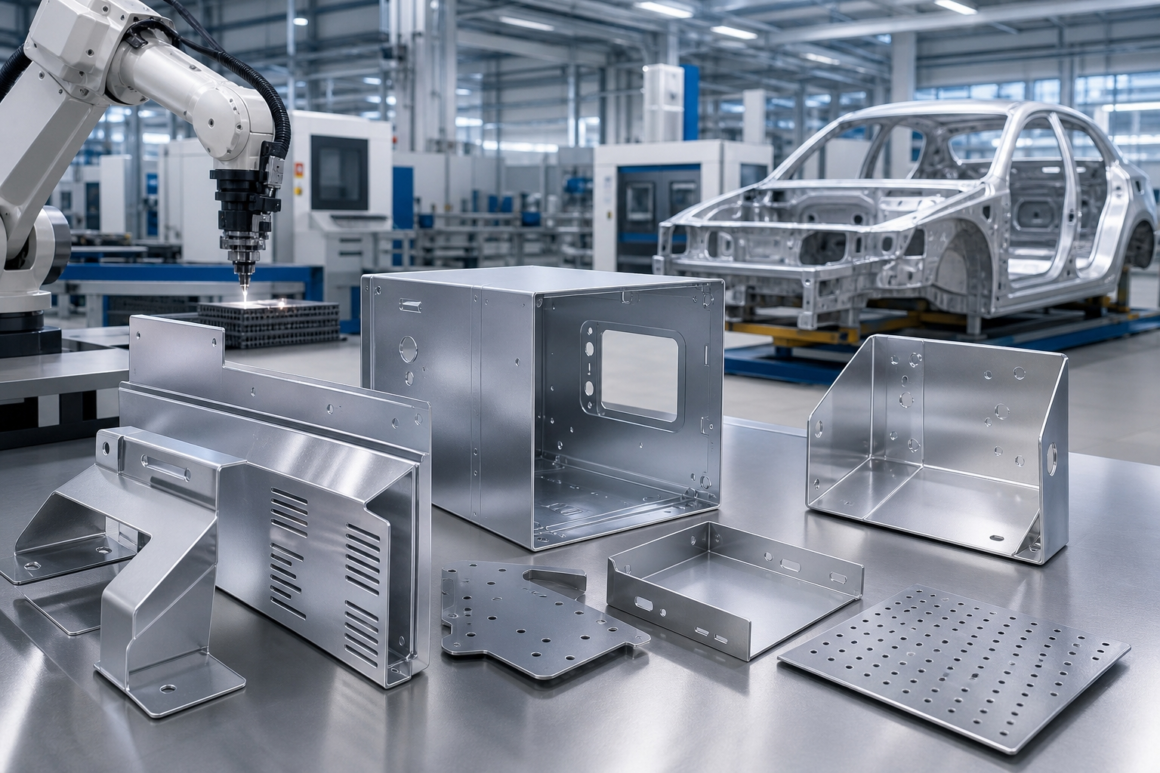
Walk into almost any manufacturing facility producing parts for aerospace, automotive, electronics, or medical equipment, and you will find aluminum sheet metal at the center of the operation. It shows up in enclosures, structural brackets, heat sinks, panels, housings, and hundreds of other components that have to perform reliably under real-world conditions.
That kind of universal adoption does not happen by accident. Engineers and product designers keep coming back to aluminum because it genuinely solves multiple problems at once, and few other materials can say the same. This article breaks down exactly why aluminum has earned its dominant position in sheet metal fabrication, what makes it behave differently from other metals during processing, and what to keep in mind when specifying it for your next project.
The Properties That Make Aluminum Stand Out
Every material decision in manufacturing involves trade-offs. You are almost always giving something up to get something else. The reason aluminum keeps winning in sheet metal applications is that its trade-offs are unusually favorable across multiple dimensions at the same time.
- Weight vs. strength. Aluminum weighs about one-third as much as steel, yet certain alloys deliver strength levels that are competitive with mild steel in structural applications. For any product where weight matters, whether that is an aircraft component, an automotive panel, or a portable enclosure, that ratio is hard to beat. You get structural integrity without the mass penalty.
- Corrosion resistance without coatings. When aluminum is exposed to air, it naturally forms a thin oxide layer on its surface. That layer acts as a barrier against further oxidation and protects the metal in most environments without any additional treatment. Steel requires paint, galvanizing, or some other surface treatment to achieve the same level of protection. Aluminum handles it on its own, which matters a lot in marine environments, outdoor installations, and chemical processing settings.
- Thermal and electrical conductivity. Aluminum conducts heat and electricity well, which makes it the default choice for heat sinks, bus bars, and electronic enclosures where thermal management is part of the design brief. Steel and most other structural metals simply cannot fill that role.
- Recyclability. Aluminum can be recycled repeatedly without degrading its material properties. The recycling process uses roughly five percent of the energy required to produce primary aluminum. For manufacturers working toward sustainability targets, that is a meaningful advantage over materials that cannot be cleanly reclaimed.
How Aluminum Behaves During Fabrication
Understanding why aluminum is popular is one thing. Understanding how it actually behaves during cutting, bending, welding, and finishing is what separates a good design from one that causes problems on the shop floor.
Aluminum is softer and more ductile than steel, which means it machines and cuts faster and with less tool wear. Laser cutting works well on aluminum sheets, producing clean edges with tight dimensional accuracy. Water jet cutting handles thicker aluminum stock without introducing heat-affected zones that could alter the material’s properties. Press brake bending creates crisp, consistent angles across a range of thicknesses.
Welding aluminum requires more care than welding steel. MIG and TIG welding both work, but the metal’s thermal conductivity means heat dissipates quickly, and its oxide layer has to be cleaned before welding to get a strong joint. Skilled fabricators who work with aluminum regularly know how to manage these characteristics, but it is worth flagging if you are evaluating suppliers who have limited aluminum welding experience.
Anodizing is the surface treatment most closely associated with aluminum, and for good reason. The process thickens the natural oxide layer electrochemically, creating a harder, more wear-resistant surface that can also accept dye for color. Type II anodizing provides a protective finish suitable for most applications, while Type III hard anodizing produces a dense coating in the 25 to 75 micron range that is used in aerospace and military components. Powder coating is the other common option, adding a decorative and protective finish in a wide range of colors.
Choosing the Right Aluminum Alloy
Not all aluminum performs the same way in fabrication. The alloy you specify has a direct effect on how the material behaves during processing, what surface finish it can achieve, and how it performs in service. Getting this decision right at the design stage avoids costly rework later.
- 5052 is one of the most widely used alloys in sheet metal fabrication. It offers excellent corrosion resistance, particularly in marine and chemical environments, and bends cleanly without cracking. It is not as strong as some other alloys, but for enclosures, panels, and components that need to hold up in harsh environments without post-fabrication coating, it is a reliable choice.
- 6061 brings higher strength and very good machinability to the table. It welds well, machines cleanly, and is available in a range of tempers. Automotive structural parts, machinery components, and anything requiring a better strength-to-weight ratio than 5052 can provide typical calls for 6061. It is slightly less formable, so tight bend radii need to be evaluated carefully.
- 3003 is the go-to for applications where formability is the primary requirement. It bends easily, resists corrosion well, and is one of the most economical aluminum alloys available. Roofing panels, general enclosures, and non-structural components where ease of forming matters more than raw strength are natural fits.
Choosing the wrong alloy for a given application often shows up as cracking during bending, poor weld quality, or premature corrosion. That is why working with a fabricator who engages with your design before production rather than just running the job is so valuable.
Where Aluminum Shows Up Across Industries
The breadth of aluminum’s application in sheet metal fabrication reflects how broadly its properties translate into practical value. A few industries where it has become nearly irreplaceable:
- Aerospace. Weight reduction is not a preference in aerospace; it is a structural requirement. Every kilogram removed from an airframe translates directly into fuel efficiency and payload capacity. Aluminum alloys have been the primary structural material in aircraft for decades, used in panels, frames, ducting, and enclosures throughout the airframe.
- Automotive. The push for lighter vehicles, driven by fuel efficiency and electric vehicle range requirements, has accelerated aluminum adoption in body panels, door structures, battery enclosures, and under-hood components. Automotive-grade aluminum fabrication requires tight dimensional tolerances and surface finish consistency at high volumes.
- Electronics and consumer products. Aluminum enclosures protect sensitive electronics while simultaneously managing heat. Laptop casings, server rack panels, display housings, and audio equipment all commonly use fabricated aluminum sheet, often anodized for both appearance and durability.
- Medical devices. Equipment housings, diagnostic instrument panels, and surgical device components use aluminum for its combination of light weight, cleanability, and corrosion resistance. Facilities working on medical applications typically require ISO 13485 certification from their fabrication partners.
- Industrial and energy. Control panels, junction boxes, solar mounting structures, and HVAC components rely on aluminum’s corrosion resistance and formability. In outdoor and utility environments where longevity without maintenance is the goal, aluminum consistently outperforms coated steel over long service lives.
What to Look for in an Aluminum Sheet Metal Fabrication Partner
Material knowledge and fabrication capability are not the same thing, and the difference shows up clearly in the quality of finished parts. A supplier who understands aluminum well will flag design issues before cutting starts, recommend the right alloy for the application, and deliver consistent results across both prototype and production quantities.
Teams at Yijin Solution, for example, work through a Design for Manufacturing review before production begins. Engineers check bend radii, wall thicknesses, hole placement relative to edges, and other features that could cause problems during fabrication or in service. That kind of front-end engagement prevents the kind of expensive surprises that show up when a design is simply handed off without review.
Certification matters here too. For applications in aerospace, automotive, or medical devices, your fabrication partner should hold the relevant quality certifications and be able to provide material traceability and dimensional inspection documentation with every order.
Capacity and lead time flexibility are worth evaluating carefully as well. Suppliers who handle aluminum exclusively in high volumes may not offer the flexibility needed for prototype iterations or small batch production. Look for a partner who can scale with your project from initial samples through full production without requiring you to change suppliers mid-development.
About Yijin Solution
Business: Yijin Solution
Spokesperson: Gavin Yi
Position: CEO
Phone: +1 626 263 5841
Email: [email protected]
Location: 760 NW 10th Ave, Homestead, FL 33030
Website: http://yijinsolution.com/
Google Maps Link: https://maps.app.goo.gl/TbnqMpxoinnottN7A
A Few Practical Considerations Before You Specify
A couple of things regularly catch designers off guard when working with aluminum sheet metal for the first time.
Springback during bending. Aluminum has a tendency to spring back slightly after a bend is formed, which means the tooling angle needs to be adjusted to account for the final position. Experienced fabricators know how to compensate for this, but if you are bending in-house or working with a shop that mainly handles steel, it is worth discussing upfront.
Galvanic corrosion risk. When aluminum contacts dissimilar metals in a wet environment, galvanic corrosion can occur. This is manageable through proper material selection for fasteners and hardware, insulating barriers, or protective coatings at contact points. It is easy to design around when you know it is a consideration, and easy to overlook when you do not.
Weld appearance vs. structural integrity. Aluminum welds can look rough compared to steel welds, even when the structural quality is sound. If appearance matters for your application, discuss surface treatment options with your fabricator before production so expectations are set correctly.