
There was a time when a chatbot was just a box.
You typed a question. It returned a sentence. Maybe it helped you reset a password. Maybe it failed politely. Either way, the interaction felt mechanical: input, output, exit.
That era is ending.
The next wave of conversational AI is not only about smarter answers. It is about presence. Personality. Mood. Memory. The strange feeling that software is no longer sitting behind a dashboard, waiting for a command, but stepping into the room as a character.
This is where AI companion platforms enter the picture. They are not simply chatbots with better scripts. They represent a new interface category: emotionally legible, identity-driven AI experiences that sit somewhere between entertainment, social software, roleplay, self-expression, and personalized computing.
Websites such as https://joi.ai/ show how quickly this category is moving from novelty to recognizable consumer behavior.
And the deeper story is not “people are talking to bots.”
The deeper story is that the interface itself is changing shape.
The Signal: AI Is Learning to Wear a Face
For years, the most successful digital products won by removing friction. Search engines compressed the web into a box. Smartphones compressed the internet into a screen. Social platforms compressed identity into feeds, profiles, and reactions.
AI companions do something different. They add friction back — deliberately.
A character has a name. A tone. A backstory. A style of speech. A visible identity. A rhythm. Sometimes even a simulated emotional arc. That extra layer may look decorative, but it changes the user experience completely.
A neutral assistant answers.
A character responds.
That difference matters because human beings do not only process information. They interpret intention. We read voice, timing, warmth, humor, confidence, hesitation. We are wired to search for social signals, even when we know the other side is software.
Character-based AI turns that instinct into a product architecture.
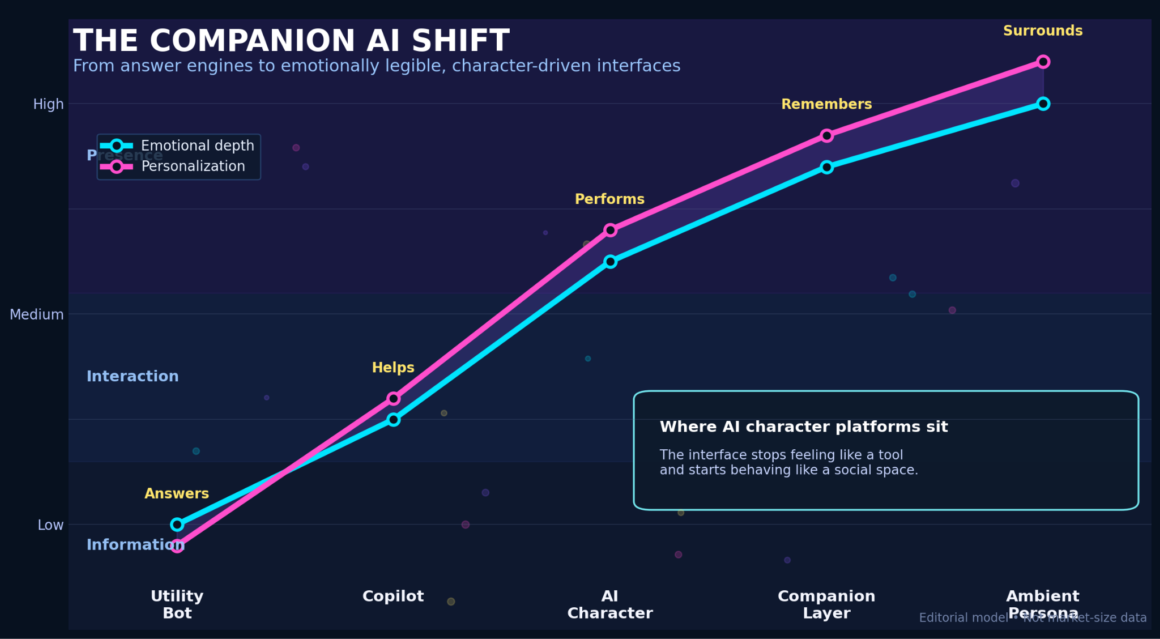
Insert Graphic: The Companion AI Shift
Suggested placement: directly after the section above.
Graphic title:
The Companion AI Shift
Visual concept:
A dark, high-contrast tech graphic showing the movement from utility bots to ambient AI personas.
| Stage | Interface Mode | User Expectation |
| Utility Bot | Answers questions | “Give me the information.” |
| Copilot | Helps complete tasks | “Help me do this faster.” |
| AI Character | Performs a personality | “Make this feel alive.” |
| Companion Layer | Remembers and adapts | “Understand my world.” |
| Ambient Persona | Moves across contexts | “Be present when I need you.” |
Caption:
The center of gravity in AI interaction is shifting from task completion to emotionally recognizable presence.
Why This Is More Than Entertainment
It is tempting to file AI companions under digital escapism and move on. That would miss the larger pattern.
Character AI sits at the intersection of several powerful trends:
First, users are getting comfortable with AI as a conversational layer. The old discomfort around “talking to machines” is fading fast, especially among younger audiences.
Second, personalization is becoming emotional, not just functional. Recommendation engines know what people click. Companion AI tries to understand what people respond to.
Third, the internet is becoming more synthetic. Feeds, images, videos, voices, influencers, avatars, and games are all absorbing generative technology. In that environment, an AI character is not an oddity. It is a natural extension of digital culture.
Fourth, loneliness and fragmented attention have created demand for low-pressure interaction. AI companions do not replace human relationships, but they do offer a kind of always-available conversational space that traditional apps rarely provide.
The point is not that AI characters are “real people.” They are not. The point is that users may still experience them as socially meaningful.
That distinction will define the category.
The New Product Formula: Personality as Infrastructure
The old software stack was built around functions.
Search. Sort. Pay. Upload. Message. Subscribe.
The companion AI stack is built around something softer but commercially powerful: personality.
A successful AI character is not only a prompt wrapped around a model. It is a designed experience. The best ones usually combine several layers:
| Layer | What It Does | Why It Matters |
| Persona Design | Defines voice, attitude, backstory, and boundaries | Gives the interaction emotional texture |
| Conversational Memory | Carries context across sessions | Makes the experience feel continuous |
| Recommendation Logic | Matches users with characters or scenarios | Reduces discovery friction |
| Safety Architecture | Filters harmful, manipulative, or age-inappropriate behavior | Protects users and the platform |
| Visual Identity | Adds images, profiles, and aesthetic cues | Turns chat into a richer media experience |
| Monetization Layer | Uses subscriptions, premium access, or usage limits | Converts attention into revenue |
The interesting part is that none of these layers works well alone.
A beautiful avatar with weak dialogue collapses quickly. A strong language model with no personality feels generic. Memory without boundaries becomes risky. Personalization without transparency feels manipulative.
Companion AI is hard because it is not only a technical problem. It is a design, trust, psychology, safety, and entertainment problem at the same time.
The User Is Not Just Asking Questions Anymore
Traditional AI assumes the user arrives with intent.
Write this email. Summarize this PDF. Generate this code. Explain this concept.
AI companions often start from a different emotional posture. The user may arrive without a task. They may want atmosphere, distraction, comfort, flirtation, imagination, roleplay, or simply a response that does not feel transactional.
That changes the success metric.
A productivity tool is judged by output quality.
A companion experience is judged by continuity, tone, emotional pacing, and whether the user wants to return.
This is why the category borrows as much from gaming and social media as it does from enterprise AI. The interface must sustain attention. It must create a loop. It must make the next message feel worth sending.
In other words: the product is not only the answer.
The product is the relationship-shaped experience around the answer.
The Business Case: Attention Is Moving Toward Synthetic Interaction
Every major consumer platform competes for attention. Social networks use feeds. Streaming platforms use endless libraries. Games use progression systems. Dating apps use matching mechanics.
AI companion platforms introduce another mechanism: responsive synthetic presence.
That may sound abstract, but commercially it is straightforward. If users feel that an AI character is personally relevant, they may spend more time inside the experience. More time creates more opportunities for subscriptions, premium characters, personalization features, media generation, voice interaction, and cross-platform expansion.
The long-term opportunity is not limited to romantic or entertainment use cases.
Character-based AI could influence:
| Sector | Possible Use Case | Why Character Matters |
| Education | Historical figures, language tutors, science explainers | Personality makes learning less sterile |
| Gaming | Non-player characters with memory and improvisation | Worlds feel more alive |
| Wellness | Reflective journaling companions and mood check-ins | Tone and trust affect engagement |
| Customer Experience | Brand mascots and guided support agents | Service becomes less robotic |
| Media | Interactive celebrities, fictional universes, story companions | Audiences become participants |
| Creator Economy | Personalized fan engagement tools | Creators scale interaction without losing style |
The strongest companies in this space will not simply build better chat windows. They will build believable interaction systems.
The Red Flags: Intimacy Needs Guardrails
The same qualities that make AI companions engaging also make them sensitive.
A tool that feels emotionally present can influence mood, attachment, decisions, and expectations. That creates serious responsibilities around safety and transparency.
The biggest risks include emotional dependency, unclear disclosure, weak age controls, privacy exposure, manipulative monetization, and characters that respond irresponsibly in moments of vulnerability.
This is where the industry needs maturity.
AI companion platforms should be clear that users are interacting with artificial systems. They should give users control over memory and personalization. They should design safety rules for emotionally intense conversations. They should avoid dark patterns that exploit loneliness or attachment.
The future of this category depends not only on how immersive the characters become, but on how responsibly platforms handle the intimacy they create.
Trust will become a product feature.
What Comes Next: From Chat Window to Living Interface
Today’s AI companions mostly live inside chat experiences. That will not remain the limit.
The next phase is likely to include voice-first characters, persistent memory, image and video generation, real-time avatars, shared character worlds, wearable access, and integration with everyday productivity tools.
Eventually, the line between “assistant,” “character,” and “interface” may blur.
Imagine a language tutor with the patience of a friend, a game character who remembers your last decision, a shopping assistant with a recognizable taste, or a wellness companion that adapts its tone when your week gets difficult.
That future will be messy. It will raise uncomfortable questions. It will produce both impressive products and irresponsible ones.
But the direction is visible.
We are moving from software that waits to be used toward software that knows how to perform presence.
The chatbot was a box.
The next interface has a face, a voice, a mood, and a memory.
And whether we treat that as entertainment, infrastructure, or a new social layer, one thing is clear: character-based AI is no longer a side experiment. It is becoming one of the most important frontiers in human-computer interaction.