
RIA compliance forms the backbone of trustworthy investment advisory operations, ensuring firms meet regulatory expectations while serving clients effectively.
Early adoption of advisor-focused compliance education sets the foundation for proactive risk management and seamless operations.
Why Compliance Matters Now
The rapid pace of regulatory change means compliance programs require advisory firms to have procedures in place, rather than simply completing paperwork, and to recognize that unexpected situations will arise.
This builds client confidence and operational resilience in a competitive marketplace.
By making compliance part of business processes, financial firms can avoid common errors like skipping documentation or not having supervisor oversight.
Training advisors to spot compliance issues can help nip problems in the bud.
Core Elements of a Robust Program
Every advisory firm needs to designate a chief compliance officer (CCO), either internally or from a third party.
The CCO typically establishes compliance policies, training, and monitoring processes to ensure compliance.
Duties also include the annual review, risk assessment, and regulatory examinations.
Good programs document the supervisory procedures appropriate to their business model, clientele, and services, and test at regular intervals whether the controls remain effective in practice, not just on paper.
Risk Assessment Fundamentals
Documents should begin with a thorough risk matrix in which the weaknesses of every aspect of operations are identified, from client onboarding to portfolio construction and management, and which is updated dynamically, as business, personnel, and external factors change.
Reduce high-impact risks like conflicts of interest or data handling to avoid consuming excessive resources.
Adjust tests for the size of the company, known weaknesses in smaller companies, and edge cases in larger companies.
Document findings and remediation thoroughly, resulting in an audit trail of due care.
Cybersecurity and Data Protection Priorities
Cybersecurity risk is a key compliance consideration, and it requires a defense-in-depth approach, including access control, encryption, and incident-response planning.
Firms also test these controls against simulated breaches to gauge their effectiveness.
Another key area of risk monitoring is vendor management, including due diligence on third-party data processors.
Compliance standards include protections against identity theft and notifications to clients.
Employees should be trained to recognize phishing attempts and to use secure communications, especially when using off-channel communications.
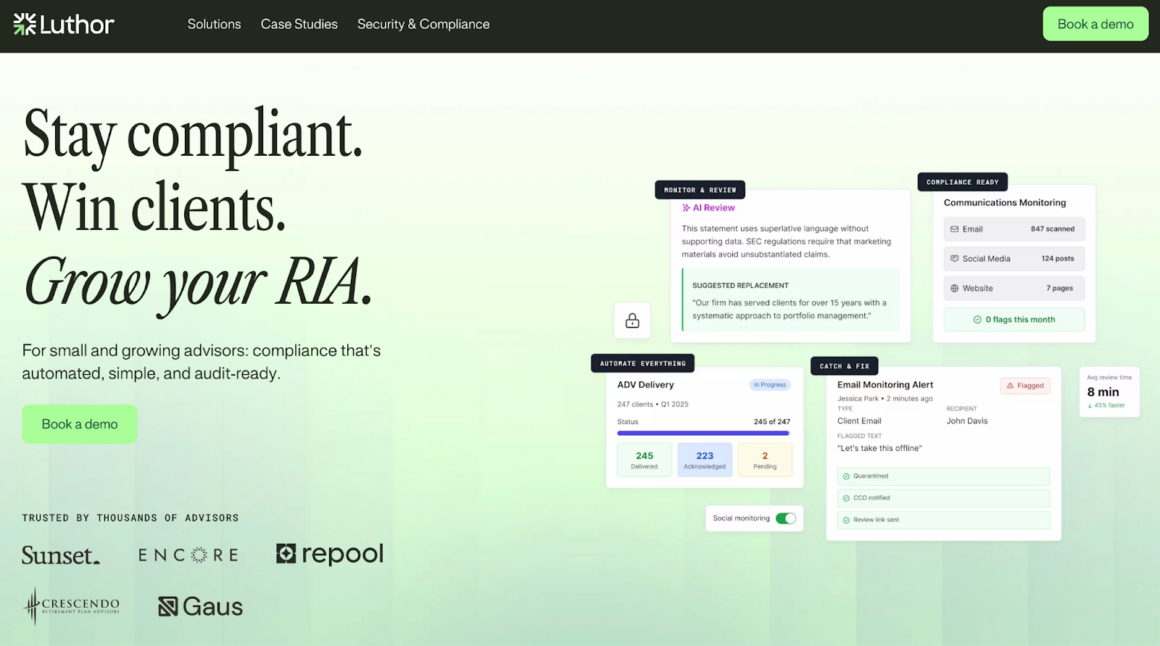
Tools such as Luthor.ai can automate the monitoring and reporting of these processes.
Training and repetition strengthens behaviors, creating consistency in protections, which offer concrete advantages when defenses are reviewed later.
Marketing and Advertising Compliance
We want a fair and balanced representation of what the service is without cherry-picking testimonials or making claims not supported by evidence.
Always review marketing copy (i.e., social media, emails, website updates, etc) for compliance.
Store business communications indefinitely for supervisory review.
Permissible testimonials and those that need to be disclosed have similar standards for all clients.
Gifts, entertainment, and political contributions over certain monetary thresholds must also be recorded with a business need.
Regular marketing practice audits by the company promote an environment of transparency and compliance, and the company provides compliance training to advisors with real-world examples to aid intuitive learning.
Fiduciary Duties in Action
Advisors must document the reasons for their recommendations, especially in rollover or alternative product situations.
Conflicts must be fully disclosed, and they must always follow internal processes that prioritize clients’ best interests over firm interests.
There may be state-specific requirements, which may differ based on your operations.
Embed these tasks into client meetings and review cycles.
Use training to connect fiduciary principles to daily decisions and minimize errors through muscle memory.
Training and Education Best Practices
In-depth, interactive training sessions with scenario-based simulation and smaller modules cover topics like social media risk, vendor risk, and compliance, helping build skills beyond the basic knowledge.
Annual refreshers and updates on changes help with retention of knowledge.
Training should be mandatory and measurable, such as through a quiz or certification.
The content can be compact for smaller firms, and more detailed for specialized teams such as the derivatives desk or crypto.
Second, advisor compliance training can meet these goals by providing this training in actual practice.
Firms find that compliance is higher when the training includes actual practice.
Interactive Session Formats
Including case studies of typical breaches and their consequences, and remediation options, as well as role-playing exams and client disputes, can aid practice under pressure.
Digital platforms provide on-demand access that fits with busy lifestyles.
Examination Preparation Roadmap
Focus on data governance, marketing integrity, and evidence of execution.
Prepare by simulating audit exams within your organization and reviewing a sample of files.
Focus on high-risk areas from your assessments.
Quarterly plan milestones include policy refreshers, testing completion deadlines, and delivery of client documents like disclosure brochures.
Lean documentation shows effectiveness without documenting everything in wide-ranging amounts of documentation.
To undertake these, chief compliance officers coordinate a firm’s readiness across functions and ease firm-wide debriefs after exams to inform subsequent cycles.
Technology Integration for Efficiency
Use automation to capture trades, communications, and exceptions with appropriate supervisory review, and with adequate disclosure of limitations and risks.
Maintain an effective process for testing your integrations and keeping policies aligned.
Vendor ecosystems expand your capacity but also introduce more risk.
Perform perpetual due diligence and find a balance between innovation and control as expectations evolve.
Building a Compliance Culture
Gain senior leadership buy-in by positively cascading compliance through the organization by integrating it into performance reviews and incentive programs.
Reward teams with good practices.
Open channels for reporting problems encourage early reporting.
Scalable programs adapt to growth and avoid expensive pitfalls.
They use bespoke templates that embrace specific risks while ensuring uniform execution across locations or affiliates.
Gifts, Entertainment, and Contributions
Create policies with preset limits and pre-approval processes.
In each document, there are its participants and business rationale.
Year-end reconciliations may reveal patterns of excesses.
Training makes understanding guidelines like de minimis exceptions or pay-to-play rules easier.
Oversight prevents regret in the face of heightened scrutiny.
Social Media and Digital Presence
Consider posts extensions of formal communications: review for material claims and archive in their entirety.
Have clear guidelines that distinguish personal use from business use.
Tools automatically take screenshots and record metadata.
Supervise in proportion to the volume of business being done, particularly dealings with clients, and require self-supervision by advisors, increasing scrutiny when warranted.
Annual Review Execution
Using all available data, including monitoring, testing, exception reports, and input from key stakeholders.
Remediating gaps is a higher priority.
Only update policies where it makes sense to.
Do not update just for the sake of it.
This cycle strengthens programs and firms, positioning them for long-term success; the documentation is a sign of maturity.
Vendor Management Essentials
Conduct initial and recurrent assessments of key providers (e.g., security, financial condition, and contract).
For multiple relationships, track through a single point and have a clear means of escalation.
Have a plan if there are issues.
We train each person to understand mutual accountability and how to reduce the ripple effects of partner failure.
Overall, RIA compliance means embedding documented best practices into cybersecurity, marketing, fiduciary, and other workflows within your business.
Teaching compliance leadership about advisor-centric processes makes it easier to adopt and maintain.