news from james gussie emergingtechs arrived this month with clear updates. The company released product notes, research summaries, and partnership announcements. Reporters shared short demos and developer previews. Readers can scan this article for concise facts and quick context. The piece highlights new tools, early deployments, and likely impacts for 2026.
Key Takeaways
- News from James Gussie Emergingtechs highlights new tools like a compact inference engine and modular sensor board accelerating edge AI deployment.
- The company launched a 65-million-parameter AI model optimized for modern phones, emphasizing efficiency and low inference costs.
- Recent strategic partnerships and a successful funding round support plans to scale R&D, manufacturing, and live robotics pilots.
- Early deployments demonstrate significant efficiency gains, such as reduced inspection times and lower energy consumption in real-world settings.
- Developers can access SDKs, datasets, and hardware documentation to rapidly prototype and test AI features on constrained devices.
- Businesses and investors benefit from clear pilot opportunities, solid partner support, and risk-mitigated investments in emerging edge technologies.
Quick News Roundup: This Month’s Headlines
This month, news from james gussie emergingtechs focused on four items. First, the firm announced a new on-device AI model and published benchmarks. Second, it revealed a hardware prototype for edge robotics. Third, it closed a funding round led by a regional investor group. Fourth, it signed an agreement with a cloud partner for joint testing. Journalists posted demo clips and developer notes. Analysts flagged the model’s efficiency and the robot’s battery life. Investors noted the funding as validation. Developers requested access to early SDKs.
New Products And Research Updates
news from james gussie emergingtechs included two product launches and several research updates. The company released a compact inference engine for mobile and a sensor board for autonomous navigation. The research team published a paper on low-power transformer pruning and an efficiency technique for multimodal input. The product pages list API details and sample code. The research notes include datasets and baseline results. Engineers reported single-digit latency for common tasks. Reviewers praised the clear documentation. Companies with limited edge budgets showed interest in trials.
AI And Machine Learning Initiatives
The AI team published models focused on smaller compute budgets. They trained a 65-million-parameter model that runs on modern phones. They optimized quantization and pruning to keep accuracy high. The group opened a beta for model distillation tools. They also released labeled datasets for urban robotics and indoor mapping. Developers can request dataset access through a streamlined form. The company plans regular model updates and clear versioning. The updates aim to reduce inference cost and speed up deployment in constrained devices.
Hardware And Robotics Developments
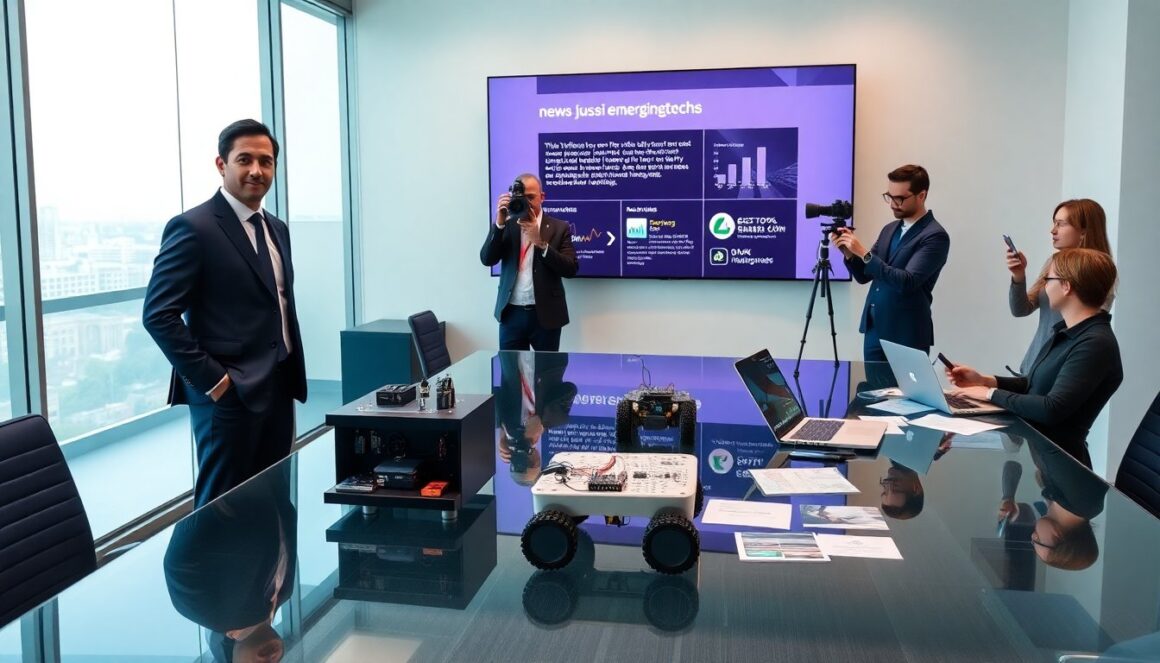
Engineers showed a new modular sensor board and a lightweight actuator kit. They tested the kit on warehouse sorting and inspection tasks. Tests showed improved uptime and simpler maintenance. The robotics team integrated the inference engine into a small wheeled platform. The platform handled mapping and obstacle avoidance with low energy draw. Production plans mention a limited developer edition later this year. Companies that run physical fleets can request pilot trials. The hardware notes include schematics and power profiles.
Strategic Partnerships, Funding, And Business Moves
news from james gussie emergingtechs detailed a funding round and two strategic deals. The funding came from venture groups and industry partners. The company used funds for R&D and manufacturing readiness. They partnered with a cloud provider for joint testing and a parts supplier for faster boards. They also signed a memorandum with a logistics firm to test robotics in live ops. Leadership appointed a head of business development to manage partner relations. The moves aim to shorten the path from prototype to pilot.
Real-World Applications And Early Deployments
Early deployments used the inference engine in retail checkout and in-facility inspection. One pilot reduced inspection time by a measurable margin. Another pilot used the sensor board for shelf monitoring. The robotics platform ran night shifts in a distribution center under supervisor control. Field teams logged data to improve maps and models. The pilots highlighted integration challenges and clear performance wins. Customers reported lower energy use and fewer false alarms. The company published a short case study that shows setup steps and measured benefits.
What This Means For Developers, Businesses, And Investors
news from james gussie emergingtechs signals practical choices for different groups. Developers gain access to compact models, SDKs, and hardware docs. They can prototype local AI features quickly and test power budgets. Businesses can pilot edge AI with short lead times and limited capital outlay. They can expect clearer SLAs and partner support. Investors can view the funding and partnerships as risk reduction and early market traction. All groups should watch product releases and beta programs. Early adopters can secure pilot slots and provide feedback that shapes the next releases.